Truly a place of legends, Melrose Abbey is one of the most historically significant architectural structures in Scotland.
Only a very small fragment survives of the first abbey church. The present building of beautiful rose-coloured stone dates almost entirely to the post-1385 rebuilding. Nevertheless, this is regarded as one of the most magnificent examples of medieval church architecture anywhere in the British Isles.
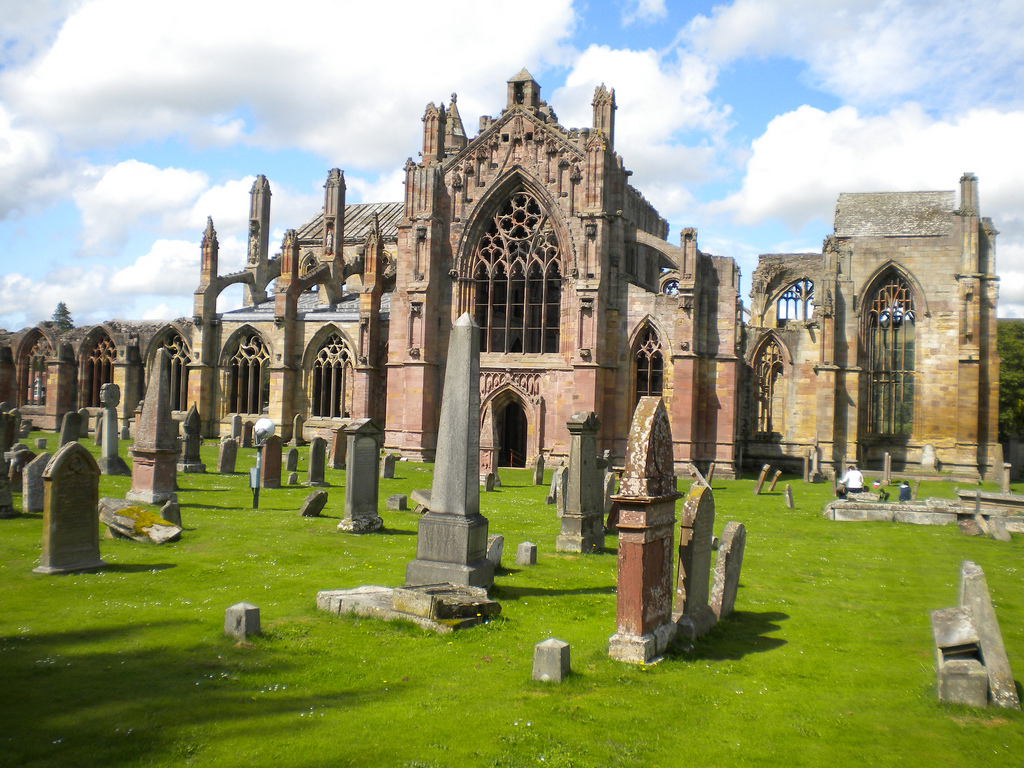
- Melrose Abbey
Highlights of the interior include the ornate stone vaulting over the presbytery, the elegant piers and the window tracery: the carved stone separating the glass.
The exterior is decorated with some of the most beguiling sculpture to be found on any medieval church building. It includes demons and hobgoblins, lute-playing angels, cooks with ladles, and of course the famous bagpipe-playing pig.
Melrose Abbey is a magnificent ruin on a grand scale, with lavishly decorated masonry.
Watch a short video about the Melrose Abbey:
It was founded by King David I in 1136, as the first Cistercian monastery in Scotland. The spot was chosen due to its association with the early Christian monastery at nearby Old Melrose founded by St Aidan in about 640.
The abbey grew rich on the wool trade, suffered through the Wars of Independence, and was substantially rebuilt in the 1380s. It continued in use as an abbey until the Protestant Reformation of 1560. After that, the existing monks were allowed to stay on: the last one died in 1590.
The abbey is the burial place of Robert the Bruce’s heart, which is marked with a commemorative carved stone plaque. Visitors can also visit a small museum housing a display of artefacts found within the abbey.
Visit the Melrose Abbey website or click here to explore the area.
 Digitourist, your fast and easy travel guide.
Geen opmerkingen:
Een reactie posten